

68·
20 hours agoCigarettes, and sunlight.
The amount of damage sunlight can do to your skin if you don’t use appropriate protection, is astonishing.
Cigarettes, and sunlight.
The amount of damage sunlight can do to your skin if you don’t use appropriate protection, is astonishing.

Because it’s for typing. And most people who type on QWERTY keyboards do so by using a pretty standard position, where pointer fingers fall on F and J.
Bu putting the clit halfway between those anchor points, you get a thumb that’s almost always available for any cursoring.
It’s right next to the G spot.
While it’s a worry for sure, I don’t see such AI creations becoming the mainstream.
Why? Because just like software, game develip needs the inspiration, the creative spark.
Sure you can create a copy of an existing software… But it either doesn’t go anywhere (because why would someone want a sloppy copy of a copy of a copy?), or it pivots to actually serving needs that exist on the market.
In other words: an artist or developer with the inspiration, the genuine original idea, will create something actually enjoyable/useful, whereas a copycat will always just be that, someone who saw an idea and decided to copy it without adding anything to it.

That screenshot is from ntfy - I hooked up the alerting from crowdsec (and a bunch of other things incl full logs from my servers, docker containers, APs and other network devices) into a tool I call Overseer. It is not yet public, so you can’t really get a screenshot like mine.
However, CrowdSec does offer a dashboard of your instance, incl prevented attacks list etc.
Literally gave you an alternative name dude. Maybug.

Oh Mexico…
This is literally just the rehearsal. Next will be Coahuila. Then Chihuahua. Maybe even Sonora.
I mean Barclay. Lieutenant Barclay.
Not even AI chips…MEMORY.

Yep.
Bailouts should never happen the way they do today and did for the past ~50 years.
Oops, you ran your business into the ground? The country NEEDS your business to not collapse?
Awesome! You’re now nationalised. You no longer chase the profits, rather, you purely provide said service the country needs, and the state will finance it.

No infrastructure that national security depends on, should be in private hands.
I’ll have you know that queefs are wondrous, entertaining, beautiful things.
So basically everything Trump isn’t.
That’s… not a caterpillar. That’s the larvae/maggot of the common cockchafer, as far as I can tell. Otherwise known as Maybug.
The black egg is century egg, a duck or chicken egg preserved in an alkaline solution (usually quicklime, ash, salt and rice hulls). It’s not horrible in the way, say, surströmming is, but it an unusual taste and texture that makes most people balk at the idea. Honestly, I’d pick it over even the onion.
Doesn’t VoidAuth already provide an LDAP compatible interface for downstream devices? I recall reading about it a while back.
Authentik (and other auth systems) are super heavy for single/low-user systems. They’re geared for more MSO use than SOHO. For auth, I’d really recommend something lighter, like Pocket-ID (as long as you don’t mind passkeys instead of passwords - Seerr and BookOrbit support WebAuthn so you can use it directly, and Jellyfin supports it with an extension for the web interface + you can set password for a Jellyfin account for clients that need direct auth). For any service that doesn’t support it, Pocket-ID has an auth gateway/wrapper you can use with your reverse proxy (I use Caddy, config is fairly straightforward).
For security, I’d recommend some automated IDP systems. You could run Suricata on your router (if it can host heavier apps), which is what Ubiquiti uses. It can talk to your firewall and set up rules on the fly to block intrusions, specific users etc.
Beyond that I’d also recommend crowdsec. One half is the detection (you hook it up as part of your reverse proxy, so it can inspect packets and full flows), and the other is the actioning (you hook it up with your router/gateway/firewall to apply blocking rules). Big benefit is that their open database (the free to access one) has all the 0-day fingerprints and CVE-specific behaviour is detected and blocked.
Here’s a quick preview of what it’s been doing today on my setup:
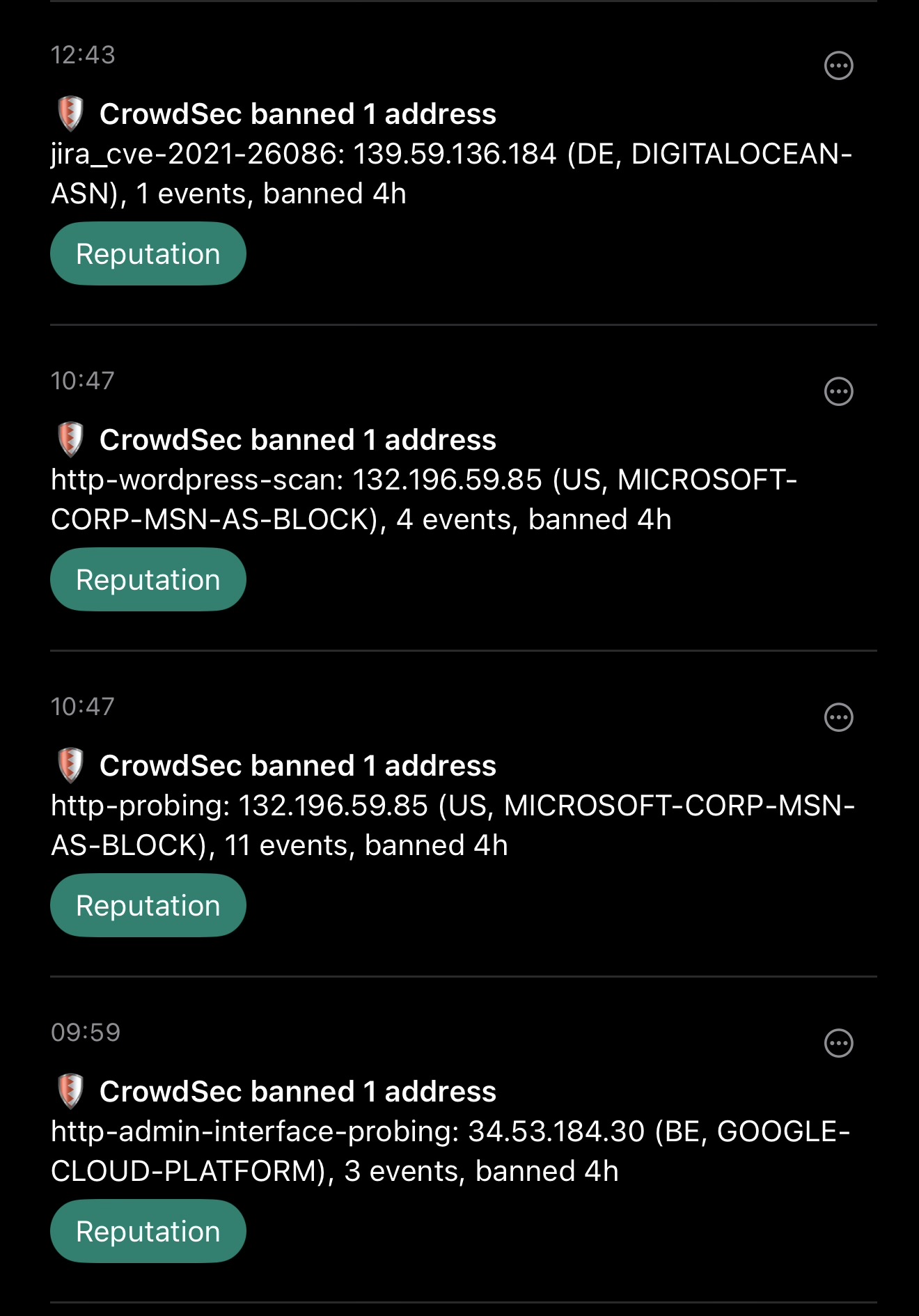
Since most indirect attackers (people randomly probing your homelab instead of directly targeting you and your services) will come from various data centers (routed through a VPS or directly relying on the infrastructure), a 4h block is generally enough to not interrupt other services while blocking attackers from probing once they hit a limit.
And of course you also need proper container network setups. For example, every single container I can, I run in rootless, read-only mode. This means the container itself can’t be edited - only a handful of paths (left as volume mount points) are RW: the config folder, media folders only if the container needs write access to them, and caches. Each path is mounted noexec so even if a backdoor is found into the container, the attacker can’t do much as they can’t execute anything they’d deliver as payload (can’t write to paths that are executable, can’t execute from writeable paths), and since the container is rootless, there aren’t many tools to run: no ash/bash/zsh/fish, no interactive shell at all, no operating system beyond a barebones Linux kernel and the bare minimum tooling needed for the specific software.
Docker networking is also hardened, with routing strictly limited, and containers only seeing other containers they need access to.
I’d also recommend using LLMs to expand on your security. No I’m not talking about giving Claude access to your entire network and homelab… But you can ask for general hardening guidance, and most frontier models will gladly walk through your stack using basic reporting (you run a command on the homelab nodes, it returns a report, you give that report to the model), and give recommendations on making it more secure.
There really isn’t one.
Trust me. I’ve worked for WBD for 4+ years specifically on the video playback component for Android devices - so my day job was literally testing streaming boxes and smart TVs.
That job made me switch from EVERY single other TV smart box, to Apple. Why, you might ask? Well, it’s because ALL streaming oriented boxes suck ass. Apple is the only one who puts appropriate hardware into their products.
Lets start with Android, my field. The ONLY usable box is the Nvidia Shield, which, to date, costs upwards of £200. For hardware that was already kinda dated in 2019, when it released 7 years ago. Even Google’s options lack RAM, and focus too much on the codec of the SoC instead power. This means nice playback, but awful user experience in menus and any other non-video functionality.
Your best bet, if you want to hand-roll a solution, is to buy a more expensive, high end SBC and hope for good support. You’ll lose DRM, though, which means no official streaming apps (or, for the ones that do work, low resolution/fidelity playback only).
If it’s Steam Link you want, get dedicated hardware for that. Even a Pi4/5 will do. Use it for Steam Link only, and keep the Apple TV for media.

Malware bundling was a risk of unofficial sources for the uTorrent installer - real malware-ification began around 2014-16.
Rapist In Chief also works
More than likely, these companies simply got rid of most of their IT/opsec teams and those savings are now biting them in the arse.