

61·
5 days agogo read article and you’ll figure out why it’s not a problem

go read article and you’ll figure out why it’s not a problem
gps sats are not in geostationary orbit
dsmac and tercom have been around for decades, some systems can also use star position for navigation

latex objects (condoms, gloves) are vulcanized
does it imply different winter versions tho?
vulcanized rubber isn’t, but it gets better if some biodegradable fillers are included (decomposes in years in favorable conditions)
idk about you, my great-grandparents were serfs
rubbers in general are highly crosslinked and this means they are not soluble in anything, and this makes biodegradation harder
what kind of alarm clock is single use?
If you live alone that’s a lot, if you live with 2 or 3 other people that’s regular amount
As a rule of thumb the most energy is used by things that deal with heat, that is heaters and heat pumps/AC, so i’d focus on efficiency of these


he can larp as great leader in miami, along cubans
from what i understand, part of it is because methadone has a very long half life, which means that patients don’t bounce from rush to crash every day but instead taper down slowly. also because it touches other receptors than opioid receptors in a way that helps in this case

It’s easier to see that this circuit is rather symmetric when you redraw it
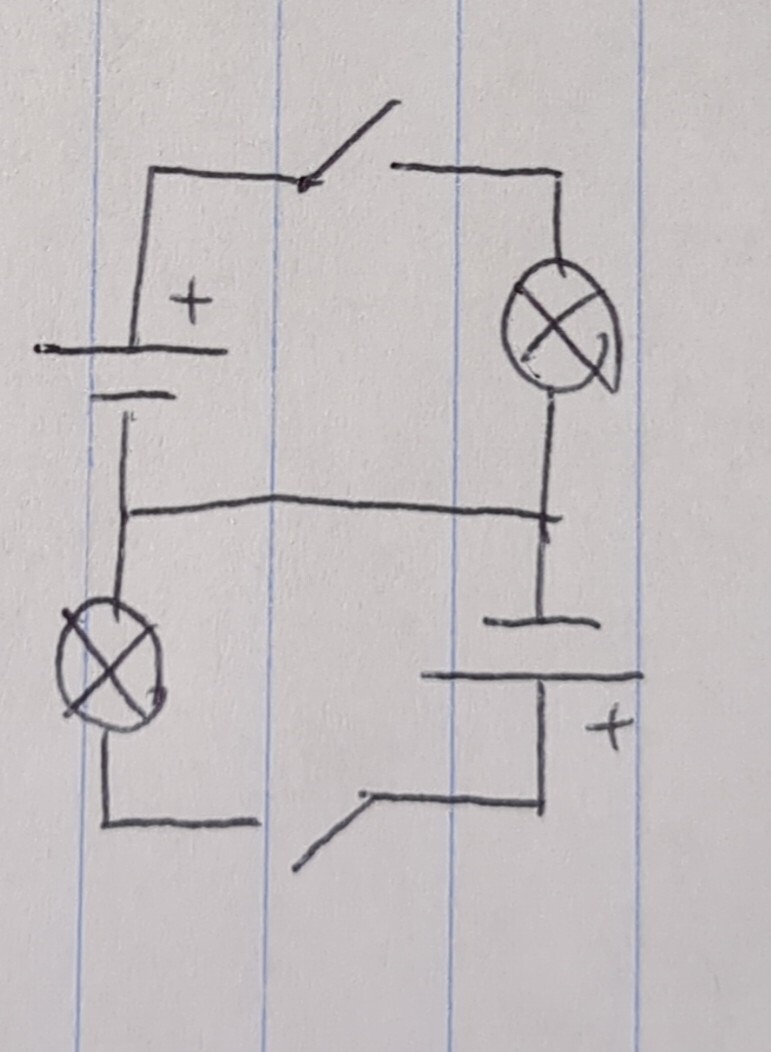
Then with both switches closed blue wire (the one in the middle) should only carry small current. If both halves are exactly the same it should be zero
In general when circuit doesn’t include nonlinear components (semiconductors most commonly) you can sum two valid solutions and you’ll get another valid solution. Note that when one switch is closed, current in blue wire goes one way and when the other is closed, in opposite way
maybe it is for power cord specifically, and the same type is used for hospital equipment. some of (modern) anesthetics are powerful solvents but not particularly flammable. maybe it also has something to do with potential extra oxygen (or nitrous oxide) content in air

in my country it used to be like this for 50 years, you get flat rate per day, counted up to fractions of day, separately for accomodation and food + everything else. you only have to keep transportation tickets
behold, disruption
i don’t mean beta-oxidation, it’s just a series of separated normal reactions. i mean something like this: when first learning about ketones, you might learn about aldol condensation, which has enol as a nucleophile and another carbonyl as electrophile. at some other point you might learn about strecker reaction, which has iminium ion as electrophile and cyanide as nucleophile. but really, what you can do is mix and match, and you can pair enolizable ketone and iminium (mannich reaction) or carbonyl and cyanide (cyanohydrin formation) and then generalize, for example you don’t need strictly ketone for mannich, you can use any electron rich conjugated system like malonate or nitroalkane anion (henry reaction) or phenol or indole. to figure this out you need to study mechanisms. these last two are usually treated as variants of friedel-crafts reaction, but really categories like this are fake
and to get that right, you need to know how these reactive intermediates look like, how reactive they are, what influences their stability which means that ochem starts with discussion of carbocations, carboanions, radicals, their shapes and orbitals involved, hyperconjugation, solvent effects and the like. and then first reactions taught are sn1/sn2, because these showcase these fundamentals nicely, and from there, it’s about introduction of more compound classes
we only had synthons introduced during lecture at around 4th year, and only for ochem path, it’s not doing a lot at that point and imo would have much more impact right after ochem intro course
i always thought that the idea of synthons should be taught early on https://en.wikipedia.org/wiki/Synthon
i’d say it’s more important to learn mechanisms because this way you can notice these patterns of reactivity easier. at some point you’d only get new reactions that are really just pieces of other reactions you know put in a new way
there’s zero reason to make chart like this, it’s both barely comprehensible and touching surface level stuff only (where are palladium couplings for one)

is there something you don’t understand? it doesn’t fucking matter what russians claim to have tested, you as nato resident are protected by nato’s ability to evaporate moscow and moscow residents survival instinct, meaning that they won’t start shit if they want to remain not evaporated. it works in any number of ways between any number of nuclear states, and can’t be undone
nothing. safety of people in nato is guaranteed by a several of icbms somewhere in wyoming or in some submarine with putin’s name on them. self-preservation is a mighty powerful instinct, and it worked for entire cold war. will easily work for a couple of decades more
it’s not because of kessler syndrome