You must log in or register to comment.
What the actual fuck⁈ “Batteries can catch on fire.” Sure, whatever could go wrong with a 1000l tank of FUCKING GASOLINE.
AAAaaaaHHhh I hate people!
Going with the “batteries catch on fire argument” is stupid. “Batteries are heavy and expensive” is probably more compelling. But yeah, wires are better solution for things going in fixed routes.
Yup batteries are not the way. By the time the batteries need to be replaced you might have helped slightly but probably not. Batteries is a illusion to going green right now. Just another product that has a demand and an easy market for it.
What would be a better alternative if you exclude the use of fossil fuels?
fixed overhead wires, as OP suggested?
The ammount of water required to put out a normal car is infinitely less than the amount required to put out a battery fire.
Not to mention the extra weight, nor the retention loss per recharge meaning we need to change batteries every 2-4 years polluting a lot more, we ain’t even talking about the energy loss when doing the conversion to electric and then again to mechanical.
The electric transport is the way to go in the future, but firts it needs to have a solid foundation, and nuclear is the way to go at least in this moment. Otherwise we are only making things worse.
Edit for those wondering about the battery degradation: https://www.geotab.com/blog/ev-battery-health/
we need to change batteries every 2-4 years
Wait, what‽ No. We don’t need to change batteries every 2-4 years. That’s what you do with TV remote controls and temperature sensors, not electric car batteries, LOL!
Electric car batteries are made to last at least 7 years (from a warranty standpoint) but in reality it’s more like 10. Not only that but they’re not single, gigantic objects. They’re made of lots of “cells” so if one of them is going bad you can replace just that one bad cell.
Anecdote: The batteries in my Prius lasted 15 years before I had to replace one of the cells. Then a year later I had to replace another one. A year after that I sold it so I have no idea how the batteries are doing right now but I’m sure another cell would probably need to be replaced by now 19 years in service).
I’d also like to point out that the latest electric car batteries are vastly superior to the ones in my Prius.
Yeah, what I’ve heard is that water cooling the batteries (like almost every EV does now) massively extends the life. Early Prius batteries had no cooling and the heat degraded them faster. 15 years is a pretty good life still.
On the subject of battery warranty:
The federal government requires manufacturers to offer an eight-year/100,000-mile warranty on all EV batteries. California does one better, mandating a warranty of 10 years or 150,000 miles. Some companies will cover a battery only if it completely stops working, while others will replace the battery if it falls below a certain capacity, usually 70% of the original, while still under warranty.
It’s important to note, a degraded battery, even with 50% of its original capacity is still useful. Someone who doesn’t need the range could drive it, or the battery could be taken apart, and have the cells repurposed or recycled. Lithium and some of the other rare metals used in batteries are quite valuable for recycling, and our abilities to do so are getting better every year.
Gasoline and diesel can be extinguished relatively easily. Extinguishing an EV means throwing it into a tub of water for a day or two
Meanwhile on the Autobahn:
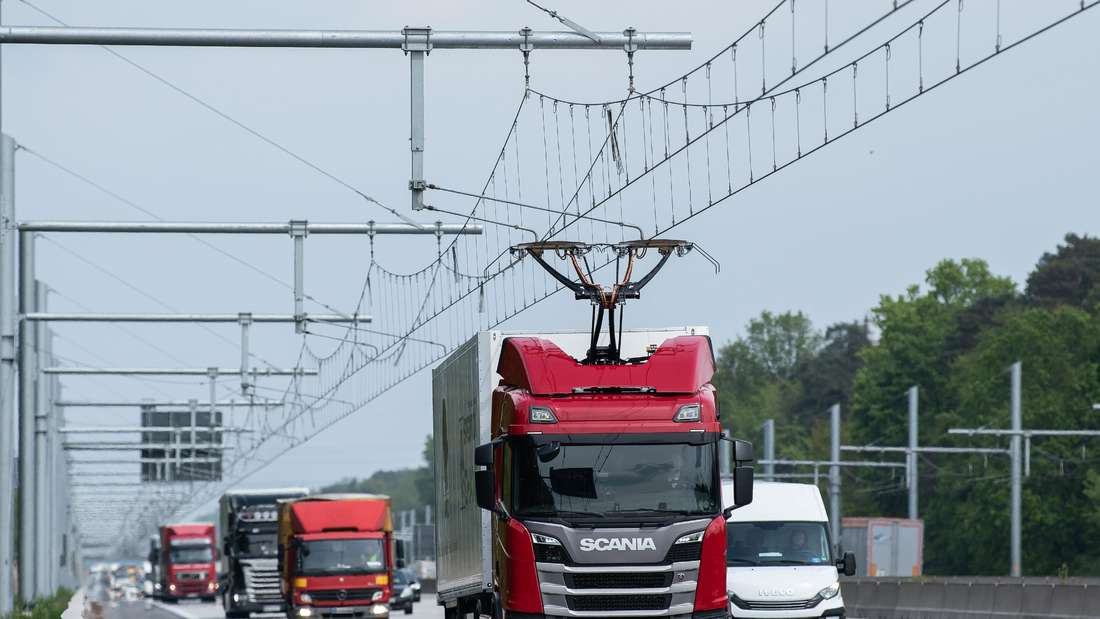
Steel rails have even less friction
This is a very nitche application. Tom Scott did a video on it.
I’m very aware of that Tom Scott video, don’t worry. It is an okay middleground, but look at the people in comments pointing out the wear on the trolley.
More about this from Tom Scott
Switzerland runs a lot of these buses. Also trams, normal buses , trains. For those people in the U.S., it’s a very effective and efficient system called public transport.
Yeah literally, what is this post even saying
Yes Switzerland is famous for its public transport
Battery fires are also less common than gasoline fires. But batteries are expensive, so overhead lines are still a good idea
We had trolley busses here in Wellington NZ for decades. The network needed an upgrade so our shortsighted council ripped it down while promising battery buses to replace the trolleys. We ended up with old, dirty, diesels chugging round our city for years, an I’m not sure we’ve gotten rid of them all yet. It was a disaster.
Same in Dunedin!
“Electric buses aren’t safe because the batteries can catch on fire”
London here running hybrids for over half a decade with no issue.
We USians are so hooked on, and controlled by, car infrastructure that we’ll come up with any lame ass excuse to undermine public transit. “Busses (or trains or any other form of public transit) aren’t perfect because of X, so we should just keep destroying our health, our communities and our planet”
People need to learn the difference between „Doesn’t catch fire“ and „Doesn’t burn AS EASY AS gasoline“.
Obviously diesel burns and batteries don’t really explode, but the only way to put out an EV fire is to dunk the car for a few days in a tub of water. And how many of those will a fire department have? 1-5?
There’s also an idea of doing this in highways.
Tom Scott video on it: https://youtu.be/_3P_S7pL7Yg
Trams… Where isn’t possible trams use trolleybus… That’s it!!! But what is sad, Eastern Europe falls into buying electric buses because it’s mainstream 😬
i actually like the aesthetic.
They are still running in The Netherlands, although only in 1 city.
Vancouver, Canada, still rocking these bad bois
Let’s face it: in most US cities there probably isn’t much aesthetic for the power lines to spoil. Just like in the grey Soviet cities where they come from
Greetings from Winterthur, a pretty nice, human-friendly, town in Switzerland which bunch of old buildings. Also called the bike-city of switzerland. It turns out that the trade off is worth it. I rather have power lines than cars or fuel powered busses.
Yes! I used to live there for most of my childhood, and thus have always considered those power lines to be a normal part of any city as a kid. Growing older and starting to visit other cities (without either trams or trolleys) I was surprised to see them missing and thought it looked strange, like a crucial piece of infrastructure was missing.
Those wires are only there if you are looking for them.
This is in my city. It looks this way because it is the biggest public transport intersection, with trolleybuses going all 4 directions meeting a tram line.
Seriously, after a while you just ignore those wires.
Buses are lame. They combine the cons of public transit with the cons of driving a car in a city. I believe in tram surpremacy.
I love trams, light rail, and subway systems. I’ve had to think long and hard about why. Busses have notable advantages for flexibility and redundancy in the system, so why do I prefer to use a railed transit solution?
For light rail, grade separated trams, and subways it’s easy: they’re faster in the city. Like… WAY faster. They don’t fight traffic so I wait a few minutes (at most) in any city with real transit solutions, ride for a short bit, hop off, and I’m there. Not having to deal with my car is freedom.
So… trams… why trams over busses?
First of all they’re bigger. There’s more elbow room and it’s easier to get on and off. It’s easier for a group of people (see: me and the kids) to all climb on and make room. The doors are larger and it’s easier to use multiple doors to load a large group so the people getting on and off a tram can go much faster. There is less shuffling along trying to wedge yourselves into the tram like you’re forced to do on a bus.
Second, they’re predictable and have a visible route. When I’m walking around, I can tell where the tram will be because I can follow the rails. I don’t have to guess what the route will be or where I should go to meet it. Yes, busses have signs every so often, but it’s not nearly the same as seeing the rails and knowing I’m on the route. This is especially true if they do move the bus route (which is what everyone who advocates for busses says is a good thing), and I don’t know it. The bus is just gone.
Thirdly, the tram drives in a predictable path. I can be near it and know where it’s going to go. In fact, whole big crowds of people do it all the time in plazas in Europe. You can walk near the rails and know that you’re still safe. Check out the plaza in front of the main train station in Amsterdam. They chose to run the trams right through it, but not allow busses since they weren’t safe and predictable enough.
Fourth, they’re quiet. Trolley Busses get this too, but trams have had it a long time. They can co-exist with a people-oriented space without being too disruptive. When you sit in a cafe talking with your friends and the tram goes by it’s no big deal. When a diesel bus goes by it’s incredibly noisy.
Lastly, they’re a community commitment. When a city installs a tram, the whole city knows that the route it travels will be supported for a long time. If you choose to live near a stop, you’ll have transit. If you’re choosing to start a business, you’ll want to be close to the tram line so customers can easily get there. The same isn’t nearly as true for a bus line. I haven’t really pinned down why yet, but there’s a very different feel to rolling along on a tram while looking at businesses to visit, and rolling along on a bus. You just don’t have the same kind of connection to the street around you on a bus that you do on a tram.
You. You get it.
I totally agree with passenger space, predictability, speed and overall commitment towards development of the parts of the city that the tram goes through.
However I personally cannot agree on trams being quiet at least in my country. They have an incredibly loud squeal when cornering at higher speeds. Sometimes one can hear a tram squealing by half a kilometer away.
The tram supremacy doesn’t lie in the inherent nature of the technology but in the way we treat it! Trams get:
- their own lane
- dedicated signals at intersections (often even priority)
- infrastructure money and thus planning effort
In short, they are (usually) treated like public transport. Busses on the other hand are too often treated like just another car that’s thrown in with the rest but also has the obligations of public transport. If you treated trams like that (sharing the road, waiting behind cars) they would be even worse than busses.
We have a ton of regular electric busses in my city in Denmark
Big powerlines everywhere in narrow city streets? People would get mad… it looks terrible. And we already have all our power cables below ground.
When I was there I found those busses really cool. But to my knowledge, they’re being phased out. They essentially combine the worst of bus and tram:
- relies on special infrastructure and thus cannot go anywhere, is more expensive than bus
- often shares the street with other cars being more vulnerable to traffic, uses tires (leading to fine particles)
I see it the other way. Trolleybuses (with either battery or diesel backup) are the best of both worlds. Much cheaper to built (compared to a tram) and doesn’t pollute in the city (compared to a full diesel bus)
Best solution: trams (or streetcars, for Americans)
The fact that “streetcar” means something unrelated to both a street and a car is above my IQ
Trams are surely better, but the simple infrastructure and relative simplicity of the drive train make trolley often cheaper than a diesel bus. Trolley buses with a small battery can also deviate from standard lines or bridge small areas between trolley lines.
Trolleybuses are the best compromise because they can (and in my country/city do) work as diesel/battery buses